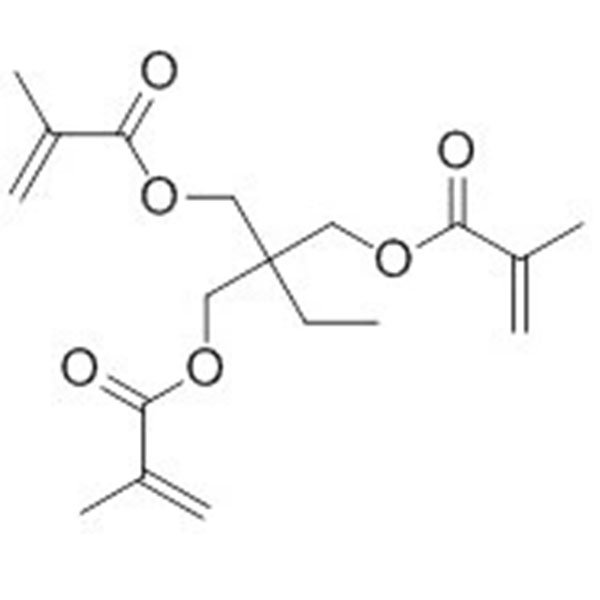
CHLUMICRYL® Monomero TMPTMA / Trimetacrilato de trimetilolpropano CAS 3290-92-4
Nombre químico: Trimetilolpropano trimetacrilato
Otros nombres: TMPTMA; ACRYESTER TMP; MIRAMER M301; Trimetacrilato de propilidintrimetilo; Trimetacrilato de propilidintrimetilo; 2,2-bis[(metacriloiloxi)metil]butil metacrilato (nombre no preferido)
N.º CAS: 3290-92-4
Fórmula molecular: 338,39544
Peso molecular: 246,43
Apariencia: líquido transparente incoloro
Ensayo: 98 %
Description
Monomero TMPTMA / Trimetacrilato de trimetilolpropano CAS 3290-92-4
Apariencia
|
líquido transparente incoloro
|
Ensayo
|
99,5 % mín.
|
Isómero
|
0,1 % máx.
|
Ácido libre
|
0,2 % máx.
|
Este producto puede sustituir al trimetacrilato de trimetilolpropano; ACRYESTER TMP; MIRAMER M301; trimetacrilato de propilidintrimetilo; trimetacrilato de propilidintrimetilo; 2,2-bis[(metacriloiloxi)metil]butil metacrilato (nombre no preferido).
Uso del trimetacrilato de trimetilolpropano
1. El trimetacrilato de trimetilolpropano se puede utilizar como agente reticulante para la reticulación con peróxido. Es adecuado para mezclar DIACRILATO DE POLIBUTADIENO, POLI(PROPILENO-CO-ETILENO), CAUCHO EPDM, caucho de isopreno y caucho de acrilonitrilo-butadieno.
2. El trimetacrilato de trimetilolpropano se puede utilizar como agente vulcanizante. Cuando el caucho sintético se vulcaniza con peróxido, el TMPTMA puede mejorar la resistencia a la corrosión, la resistencia al envejecimiento y la dureza, así como la resistencia al calor. El TMPTMA se plastifica durante la mezcla y vulcaniza el efecto endurecedor original, por lo que se puede utilizar para NBR, EPDM y caucho acrílico.
3. El trimetacrilato de trimetilolpropano se puede utilizar como agente reticulante. El TMPTMA puede reducir la dosis de radiación, acortar el tiempo de radiación, aumentar la densidad de reticulación y tiene las características de baja precisión, alto grado de reticulación, baja presión de vapor y rápida velocidad de curado. Se puede utilizar para tintas fotopolimerizables y materiales poliméricos.
4. El PVC se mezcla en el agente sellador de la carrocería del automóvil, el agente de calafateo y todo el moldeado de soluciones de PVC.
5. Activador auxiliar de vulcanización de cauchos especiales, caucho de etileno-propileno-propileno y caucho EPDM, caucho clorado, caucho de silicona, poliuretano, copolímero de etileno/acetato de vinilo (EVA), elastómero de polietileno clorado (CPE) y otros cauchos especiales. La vulcanización es muy difícil y, por lo general, se utilizan peróxidos orgánicos (como DCP, BPO) para la vulcanización. Si se utiliza un solo peróxido orgánico para la vulcanización, el tiempo de vulcanización es demasiado largo y la vulcanización es insuficiente, y es difícil garantizar unas buenas propiedades mecánicas y físicas. Por lo tanto, es necesario añadir TMPTMA como agente vulcanizante para obtener buenos resultados.
6. Por ejemplo, en el caucho orgánico fluorado, etc., cuando se utiliza DCP para la vulcanización, si se utiliza un aditivo de 1-4 % de TMPTMA como agente vulcanizante, no solo se puede acortar considerablemente el tiempo de vulcanización, aumentar el grado de vulcanización y reducir la cantidad de DCP, sino que también se mejora significativamente la maquinaria del producto. Resistencia, resistencia al desgaste, resistencia a los disolventes y resistencia a la corrosión, etc. En el proceso de vulcanización del caucho que contiene flúor, el doble enlace de la molécula de TMPTMA no solo participa en la reacción de reticulación de la vulcanización, sino que también actúa como aceptor de haluros de hidrógeno (HF, HCL, etc.), absorbiendo los haluros de hidrógeno liberados durante el procesamiento, lo que no solo mejora la calidad del producto, sino que también reduce en gran medida la corrosividad del caucho vulcanizado. El compuesto de caucho que contiene TMPTMA tiene un efecto plastificante durante la mezcla y un efecto endurecedor después de la vulcanización.
Trimetilolpropano trimetacrilato Embalaje y envío
Embalaje: 1/kg; 200 kg/bidón
Entrega: por mar, aire y DHL
Trimetilolpropano trimetacrilato Almacenamiento
Almacenar a baja temperatura y evitar la luz.
¡Póngase en contacto con nosotros ahora!
Si necesita precios y muestras de prueba, rellene el siguiente formulario con sus datos de contacto y nos pondremos en contacto con usted en un plazo de 24 horas. También puede enviarme un correo electrónico a info@changhongchemical.com durante el horario laboral (de 8:30 a 18:00, UTC+8, de lunes a sábado) o utilizar el chat en vivo de la página web para obtener una respuesta rápida.
The importance of the glass transition temperature (Tg) of acrylic resins, which are commonly used in coating formulations, is briefly described as an example
The glass transition temperature (Tg) is the lowest temperature at which the polymer chain segments can move, and is directly related to the flexibility of the molecular chains. For acrylic resins commonly used in coating formulations, the film becomes soft above its glass transition temperature, so they are usually used below the glass transition temperature, so we also want to use acrylic resins with a higher glass transition temperature. The glass transition temperature (Tg) of acrylic resins is a very important technical indicator, which must be designed and selected correctly, and its importance is mainly expressed in the following aspects.
One, the engineer in the design of paint formulations with acrylic resin, once the coating species, performance and other comprehensive requirements to determine the glass transition temperature of acrylic resin Tg, basically also determines the choice of synthetic resin monomer, but also basically determines the performance of acrylic resin and paint after the performance of the paint. The higher the Tg value of the acrylic resin, the better the solvent and corrosion resistance of the coating film; conversely, the lower the Tg value of the resin, the worse the corrosion and solvent resistance of the coating film. Therefore, among the many technical indicators of acrylic resins, the Tg value has a greater impact on the resin and the performance of the coating film.
Second, under the same acrylic resin synthesis reaction conditions, the higher the Tg of the resin, the greater the final viscosity of the resin reaction, that is, the higher the average molecular weight; conversely, the lower the Tg of the resin, the lower the final viscosity of the resin reaction, that is, the lower the average molecular weight.
The higher the Tg value, the harder the film and the stronger the scratch resistance, but care should be taken to adjust the paint formulation and not to make the film brittle; conversely, the lower the Tg value, the lower the film hardness and the worse the scratch resistance. We often encounter high temperatures in summer when the film is easy to become soft, back to sticky, easy to be contaminated phenomenon, which is the film-forming resin Tg high or low impact on the film hardness and scratch resistance of the visual performance.
Fourth, the higher the Tg of the acrylic resin, the better the solvent release of the coating, the better the dry rate of the film after painting; conversely, the worse the solvent release, the worse the dry rate of the film after painting the resin.



Liam Carter –
Swift delivery, exceptional quality. Couldn’t ask for more! Highly satisfied with my purchase.